
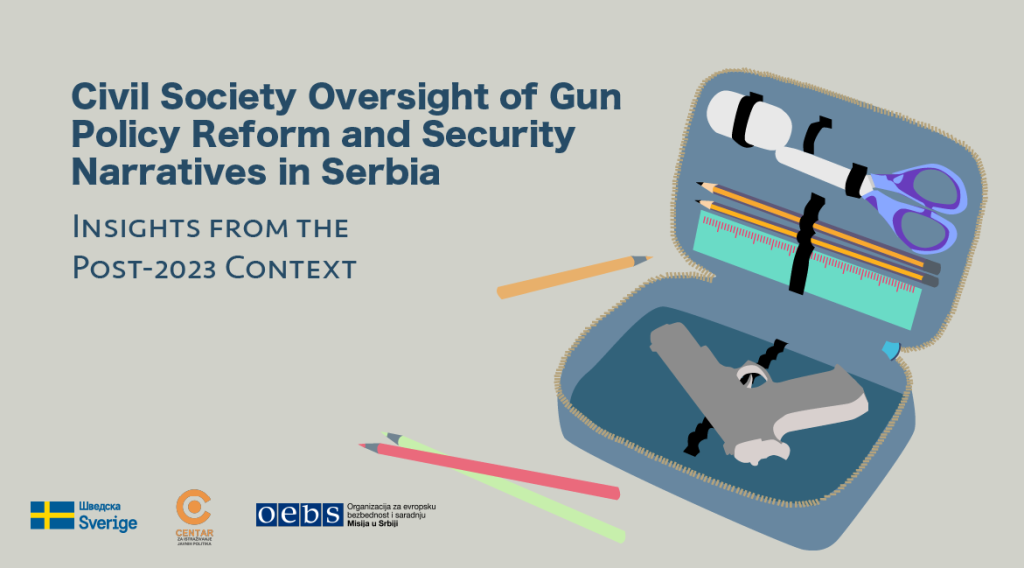
The project, titled Civil Oversight of the Reform of “Gun Policy” and Security Narratives in Serbia: Insights from the Post-2023 Context, will be carried out between September 2025 and March 2026.
In May 2023, Serbia experienced the two most tragic mass shootings in its recent history—one at the “Vladislav Ribnikar” Elementary School in Belgrade, and the other in the vicinity of Mladenovac and Smederevo. These events, which resulted in 19 deaths and more than 20 injuries, triggered a strong public reaction and a series of government measures, including an amnesty for the voluntary surrender of arms, a moratorium on the issuance of new gun permits, the tightening of criteria for gun ownership, and increased security in schools through police presence.
The main goal of the project is to independently assess whether these measures represented a substantive reform of security policy or, conversely, led to its further securitization—that is, the process by which a social problem is framed as a security issue requiring special institutional measures. The project will specifically focus on the impact of state responses on the “culture of gun ownership”, youth safety, and approaches that incorporate trauma awareness and violence prevention.
The research is based on a multi-method approach, combining quantitative and qualitative methods, including analysis of official data, government documents, political statements, and media narratives. It will also include six in-depth interviews with experts from institutions, civil society, the legal field, and the media, as well as a focus group with representatives of civil society organizations. Additionally, the project will compare Serbia’s experience with that of European countries such as Finland and Germany, which have developed trauma-informed approaches to similar challenges.
The project’s final outcome will be a comprehensive report providing an analysis of Serbia’s security policy after May 2023. The report will cover trends in gun control, institutional measures, public perceptions, and specific implications for youth, schools, and families. Research findings will be presented at a final conference with the participation of representatives from institutions, civil society, the media, and educational organizations.
This project represents an important contribution to the development of civil expertise and civilian oversight of security policies in Serbia. It will present an assessment of the effectiveness and nature of institutional responses to the 2023 mass killings, as well as recommendations for improving institutional accountability and crisis response. Particular attention will be given to how violence prevention, mental health, and trauma-informed approaches are integrated into policies affecting students, schools, and families, with the goal of fostering a safety culture centered on the well-being of young people.